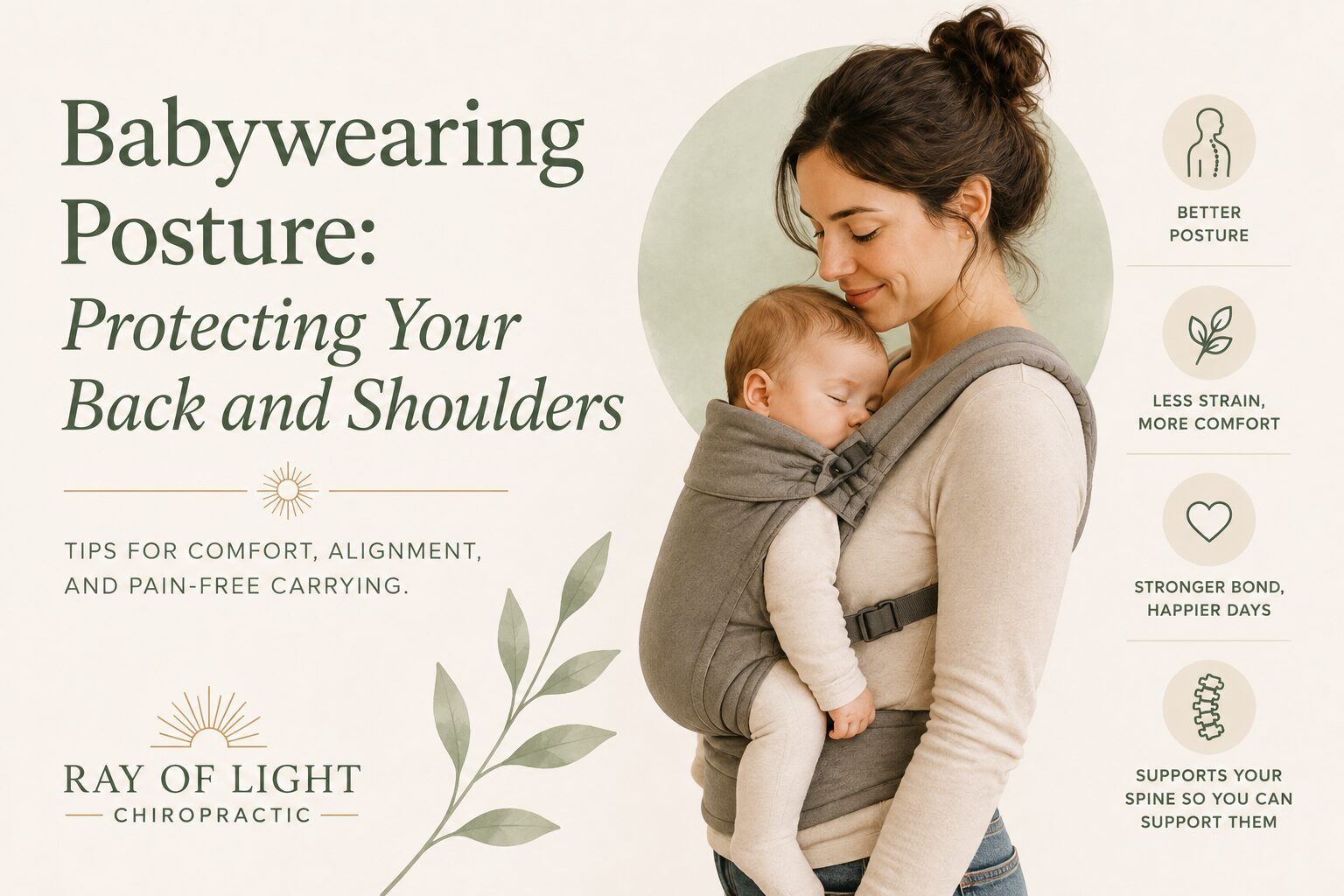
Babywearing Posture: Protecting Your Own Back and Shoulders
September 3, 2026
The part of babywearing nobody warns new parents about.
Your baby isn’t the only one who needs good support in that carrier — your spine does too.
Babywearing is one of the great joys of early parenthood — hands free, baby close, bonding built right into your day. What often goes unmentioned is what happens to your body after months of carrying a growing baby in a wrap, sling, or structured carrier.
Neck strain, shoulder tightness, and low back pain are incredibly common, and they’re almost always fixable.
At Ray of Light Chiropractic in Topsfield, we see plenty of parents dealing with exactly this kind of postural strain, and small adjustments make a bigger difference than most people expect.
Why Babywearing Strains the Body
- Forward head posture from looking down at baby frequently
- Rounded shoulders from carrier straps pulling forward
- An anterior pelvic tilt from the added front-loaded weight
- Uneven strain if you favor one hip or shoulder with a sling-style carrier
None of this means you should stop babywearing — it just means a little attention to posture and setup goes a long way.
Setting Up Your Carrier Correctly
Key Fit Points
- Baby should sit high enough to kiss — a low carry pulls your whole upper body forward.
- Straps should be snug, not loose, so weight doesn’t sag away from your body.
- Baby’s weight should sit close to your center of gravity, not hanging out in front.
- Use both shoulders with a structured carrier, rather than a single-shoulder style, for long wears.
Postural Habits That Help
- Stand tall, with your ribs stacked over your hips, rather than leaning back to counterbalance baby’s weight.
- Engage your core gently rather than letting your low back arch to support the load.
- Switch which hip or shoulder carries the weight if using a sling-style carrier.
- Take breaks to stretch your neck, chest, and shoulders throughout the day.
Stretches to Counter Babywearing Strain
- Doorway chest stretch — open the chest and shoulders that carriers tend to round forward.
- Chin tucks — gently counter the forward head posture from looking down at baby.
- Cat-cow stretch — mobilize the spine after a long babywearing session.
- Child’s pose — release low back tension at the end of the day.
When Chiropractic Care Can Help
If neck, shoulder, or low back pain from babywearing has become a regular part of your day, that’s not something you need to just live with.
At Ray of Light Chiropractic, we assess the specific pattern of strain in your posture and work to restore better alignment and movement, so carrying your baby feels sustainable rather than punishing.
A note from Dr. Laura: I hear from so many Topsfield parents who assume shoulder and back pain is just the price of babywearing. It doesn’t have to be — a few adjustments to your setup and your own alignment usually make a real difference.
Frequently Asked Questions
Why does my back hurt so much from babywearing?
Carrying a growing baby shifts your center of gravity forward, which often leads to compensations like an arched low back or rounded shoulders.
Over time, these compensations create the strain and pain many parents feel.
What’s the correct posture for babywearing?
Aim to stand tall with your ribs stacked over your hips rather than leaning back, keep baby positioned high enough to kiss, and make sure carrier straps are snug so weight stays close to your body rather than pulling you forward.
Can a chiropractor help with babywearing-related pain?
Yes. Chiropractic care can address the specific postural strain patterns caused by carrying a baby regularly, restoring better alignment and reducing the neck, shoulder, and back pain that often comes with it.
Is it better to use a two-shoulder carrier than a sling?
For long or frequent wears, a two-shoulder structured carrier generally distributes weight more evenly than a single-shoulder sling, which can help reduce one-sided strain.
How can I prevent shoulder pain from babywearing?
Make sure your carrier straps are properly adjusted and snug, alternate carrying sides if using a sling, and incorporate simple stretches like doorway chest openers and chin tucks throughout the day.
We’re Here When You’re Ready
Have questions about what you just read, or want to see how we can help your family?
We’d love to hear from you — reach out or book online with Ray of Light Chiropractic in Topsfield today.
Book Online or Contact Ray of Light Chiropractic
Dr. Laura · Ray of Light Chiropractic, PC · Topsfield, Massachusetts